
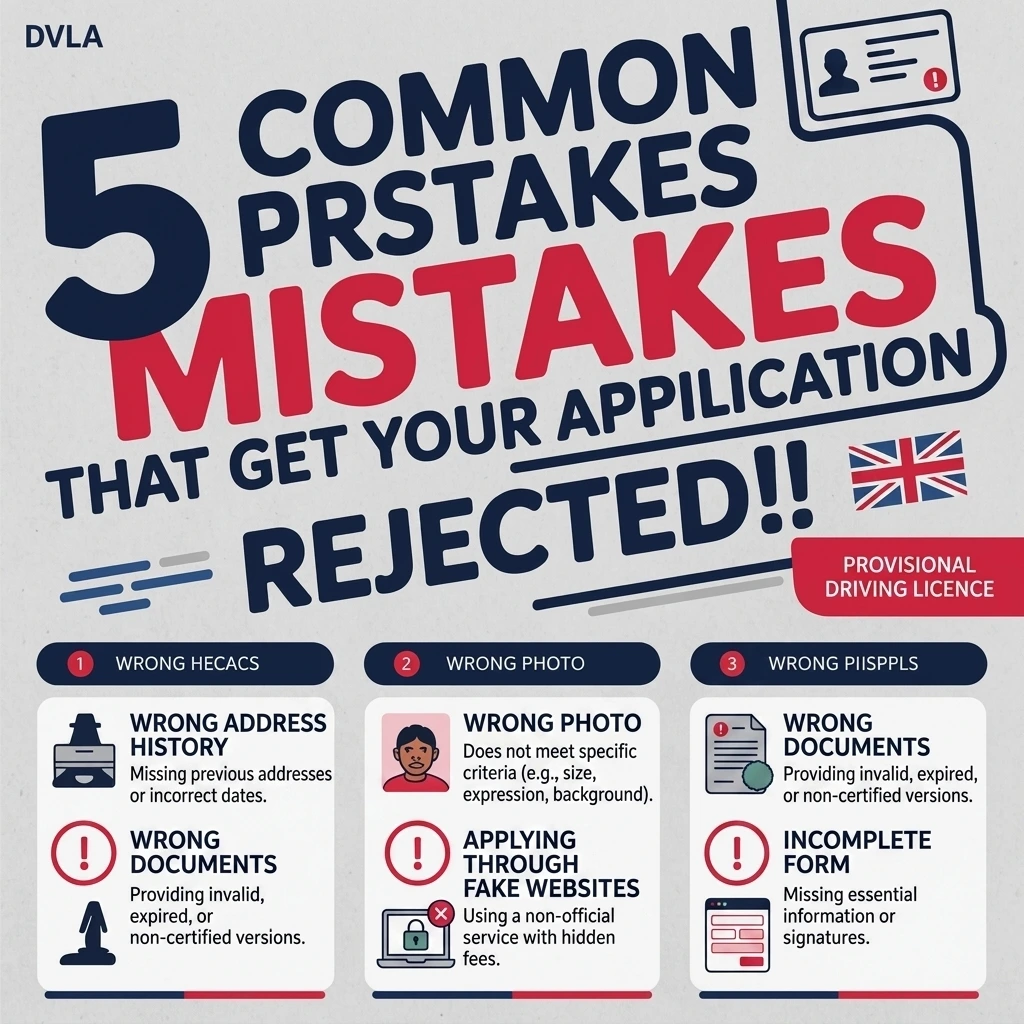
Common Mistakes When Applying for a UK Driving Licence
Most driving licence applications that get delayed or sent back aren’t rejected because of anything complicated. They’re rejected over something small a typo in a name, a photo with the wrong background, a proof of address that’s a week too old. None of it is difficult to get right. It’s just easy to get wrong when you’re rushing through a form you’ve only ever filled in once.
This guide covers the common mistakes when applying for a UK driving licence that genuinely cause the most delays, broken into three chronological phases: the paperwork and personal detail errors you make while filling in the form, the photo pitfalls that trip up even careful applicants, and the identity document trap that catches people out at the final hurdle. Get these right, and there’s really nothing standing between you and a smooth application.
Understanding the UK Driving Licence Application Process
Who Can Apply?
Most UK residents aged 15 years and 9 months or older (for a provisional licence) can apply, provided they meet basic residency and medical fitness requirements. does uk driving licence show middle name
Online vs Postal Applications
Applying online through GOV.UK is faster and cheaper than applying by post, and it allows for smoother digital identity verification if you hold a valid passport. Postal applications require the paper D1 or D750 form (depending on your specific situation) and generally take longer to process.
Documents You’ll Need
- Valid identity documents (a passport, in most cases)
- A compliant passport-style photo
- Proof of address, where requested
- Your National Insurance number, if known
- Payment for the application fee, where applicable
Phase 1: Paperwork and Personal Detail Errors
This is where the whole application starts, and it’s genuinely where the majority of avoidable delays begin.
Incorrect Personal Information
Even a single-digit typo can cause real problems. A wrong date of birth, a mistyped National Insurance number, or a name spelled slightly differently to your passport — any of these can flag your application for manual review, adding days or weeks.
Using the Wrong Application Form
Different situations call for different forms a first provisional application, a licence exchange, and a renewal are not interchangeable processes. Using the wrong form or service is a genuine and surprisingly common mistake, particularly for people who’ve searched generically rather than for their specific situation.
Missing Mandatory Information
Leaving a required field blank, whether accidentally or because you weren’t sure how to answer it, stops your application from being processed at all until it’s completed properly.
Incorrect or Outdated Address
Your address must be your current, legal residential address — not a previous one, and not a temporary one you’re not planning to stay at. Mismatched address information is one of the single biggest causes of identity verification failure.
Name Mismatch with Official Documents
If you’ve changed your name — through marriage, deed poll, or any other legal route — every document in your application needs to reflect your current legal name consistently. A licence application using your maiden name alongside a passport showing your married name will almost always trigger a delay.
Incorrect Payment Details
Where a fee applies, a failed or mismatched payment simply stops the application in its tracks until it’s resolved. Double-check your card details before submitting, rather than assuming the payment went through correctly.
Missing Declarations or Confirmations
Medical declarations, eyesight confirmations, and other required checkboxes aren’t optional formalities — skipping one, even accidentally, means your application is genuinely incomplete.
Checklist: Before You Submit
- Name matches exactly across every document
- Date of birth entered correctly
- National Insurance number double-checked, if provided
- Current address entered in full, postcode included
- The correct form or service selected for your specific situation
- Every required field completed, not left blank
- Payment details confirmed before submitting
- All medical and eyesight declarations answered honestly
Phase 2: The Photo Pitfalls
This is where perfectly reasonable, careful applicants still get caught out, simply because DVLA photo standards are stricter than most people expect.
Wrong Photo Size or Format
UK driving licence photos must measure 35mm x 45mm — the same specification used for UK passports. Using an incorrectly sized or cropped photo is one of the most common causes of outright photo rejection.
Poor Image Quality
Blurry, low-resolution, or poorly lit images get rejected, particularly since the DVLA now uses automated digital scanning on uploaded photos as part of the online application process.
Wearing Hats, Sunglasses, or Inappropriate Accessories
Head coverings are only accepted for genuine religious or medical reasons — everyday hats and caps are not. Sunglasses and tinted glasses are never accepted; standard glasses are usually fine, provided there’s no glare and your eyes remain clearly visible.
Background and Lighting Problems
The required background is plain light grey or cream, with no patterns, shadows, or clutter behind you. Uneven lighting causing shadows across your face is one of the most frequent automatic rejection triggers.
Using an Outdated Photograph
Your photo needs to be a genuine, current likeness — generally taken within the last month. Reusing an old passport photo that no longer resembles you (after a significant change in appearance) can cause problems, even if the technical specifications are otherwise correct.
Digital Photo Upload Mistakes
When applying online, you may be offered the option to reuse your existing passport photo automatically. This only works smoothly if that photo is still a genuine, current likeness — don’t select this option out of convenience if your appearance has changed significantly since it was taken.
Quick-Reference: DVLA Photo Requirements
| Requirement | Standard |
|---|---|
| Size | 35mm x 45mm |
| Background | Plain light grey or cream, no shadows or patterns |
| Expression | Neutral, mouth closed, eyes open and clearly visible |
| Head coverings | Only for religious or medical reasons |
| Glasses | Allowed if no glare and eyes are clearly visible; no tinted lenses |
| Photo age | Should be a current likeness, generally taken within the last month |
| Format | Colour, sharp focus, no red-eye |
Phase 3: The Identity Document Trap
This is the stage where applicants often assume they’re nearly done, only to discover their supporting documents aren’t quite right.
Providing Incorrect Identity Documents
A valid passport is by far the smoothest route to identity verification. Using an expired passport, or one where the name doesn’t currently match your legal name, is a common and entirely avoidable stumbling block.
Passport Details That Don’t Match
Even a slight discrepancy — a middle name included on your passport but left off your application, for example — can cause your identity check to fail and require manual review.
Problems with Digital Identity Verification
Online identity checks, which may include passport scanning and facial matching, can fail due to poor lighting, glare on the passport’s photo page, or simply holding the document at an awkward angle during the scan. This is usually a simple retry fix, not a fundamental problem, but it does slow things down if you’re not prepared for it.
Missing Supporting Documents
This is the trap that catches out the most people at the final hurdle: sending the wrong type of proof of residency, or none at all, where it’s required. A utility bill that’s more than three months old, a document addressed to an old address, or a document that simply isn’t on the accepted list can all cause your otherwise-complete application to stall.
- Accepted proof of address is typically a recent, official document — a utility bill, bank statement, or official government correspondence, generally dated within the last three months
- A document addressed to a previous address doesn’t count, even if you genuinely still receive post there occasionally
- Screenshots or photocopies of proof of address are often not accepted where an original or clear scan is specifically requested — check the exact requirement for your application type
Incorrect Residency Information
Where your application asks about your residency status or history, provide this accurately and completely. Vague or inconsistent answers here can trigger additional manual checks that significantly slow down processing. how to change address on uk driving licence
Other Common Reasons Applications Are Delayed
Medical Information Not Declared
Failing to declare a relevant medical condition isn’t just a paperwork gap — it’s a genuine legal requirement under the Road Traffic Act 1988, and skipping it can cause both processing delays and more serious issues later.
Responding Late to DVLA Requests
If the DVLA contacts you for further information, processing pauses entirely until you respond. Check your email (including spam folders) regularly while your application is pending.
Submitting Incomplete Applications
Rushing through the form and submitting before every section is genuinely complete is one of the most avoidable causes of delay on this entire list. update title on uk driving licence mr mrs ms
Errors When Applying Online
Session timeouts, accidentally navigating away mid-form, or submitting before reviewing your answers can all introduce errors that a slower, more careful pass through the form would have caught.
Mistakes on Paper Application Forms
Illegible handwriting, missing signatures, and sections left blank are all far more common on paper D1/D750 applications than online ones another reason the online route tends to be smoother where it’s available to you. change name on uk driving licence after divorce
How to Check Your Application Before You Submit It
- Personal details match exactly across every document
- Address is current, complete, and correctly formatted
- Identity documents are valid, in date, and consistent with your application
- Photograph meets the size, background, and expression standards above
- Supporting evidence (proof of address, etc.) is the correct type and recent enough
- Application form is the correct one for your specific situation
- Payment details are confirmed and correct, where applicable
- Final review completed before hitting submit read every section once more
What to Do If the DVLA Returns Your Application
Why Applications Are Returned
Most returns come down to missing, incorrect, or unverifiable information not a fundamental problem with your eligibility. A returned application is usually a fixable delay, not a rejection of your right to hold a licence.
How to Correct Mistakes
Read the DVLA’s correspondence carefully — it will typically specify exactly what needs correcting or resubmitting, rather than leaving you guessing.
How to Resubmit
Correct the specific issue identified, double-check nothing else has changed or been affected, and resubmit through the same channel (online or postal) as your original application.
How Delays Affect Processing Times
Each round of correction and resubmission adds real time to your overall wait, which is exactly why getting things right the first time using the checklists above is worth the extra few minutes it takes.
Why the DVLA Sends Driving Licence Applications Back
Applications are commonly returned because essential information is missing, incorrect, or simply can’t be verified against official records. This isn’t an exhaustive list outcomes always depend on individual circumstances but these are the most frequently seen issues. is it illegal to have wrong address on uk licence
| Common Issue | Why It Causes Problems | How to Avoid It |
|---|---|---|
| Incorrect personal details | Identity cannot be verified | Check names, dates of birth, and licence details carefully |
| Name doesn’t match supporting documents | Records cannot be matched | Ensure all documents use the same legal name |
| Incorrect or incomplete address | Licence cannot be processed correctly | Use your current residential address |
| Missing identity documents | Verification cannot be completed | Include all required documents |
| Photo does not meet DVLA standards | Photo is unsuitable for a photocard licence | Follow the official GOV.UK photo requirements |
| Incomplete application form | Required information is missing | Review every section before submitting |
| Missing signature (paper forms) | Application may be invalid | Sign all required sections before posting |
| Incorrect fee or payment issue | Application cannot proceed | Check the latest fee and payment instructions |
| Missing responses to DVLA requests | Processing stops until information is received | Reply promptly to all correspondence |
| Inconsistent information across documents | Manual checks may be required | Make sure all submitted information is accurate and consistent |
These are the most common issues, not an exhaustive list — actual outcomes always depend on your individual circumstances, so check the latest GOV.UK guidance for anything specific to your situation.
Frequently Asked Questions
Why did the DVLA reject my application? The most common causes are mismatched personal details, an unsuitable photo, missing or incorrect proof of address, or a failed identity verification check. Reviewing every section carefully before submitting helps avoid most of these.
What photo does the DVLA accept? A colour photo measuring 35mm x 45mm, on a plain light grey or cream background, with a neutral expression and clearly visible eyes. Sunglasses and everyday head coverings aren’t accepted; religious and medical head coverings are.
Can I correct mistakes after submitting my application? Often, yes, depending on what needs correcting and how far your application has progressed. Contacting the DVLA promptly after spotting an error is generally the quickest way to resolve it.
How long does it take to process a corrected application? This varies depending on the nature of the correction and current processing volumes. Straightforward corrections are typically resolved faster than ones requiring fresh document verification.
What identity documents do I need? A valid passport is the smoothest option for identity verification. Where a passport isn’t available, alternative accepted documents may apply depending on your specific application type.
What happens if my name doesn’t match my passport? Your application will likely be flagged for manual review, since your identity can’t be automatically verified. Ensure your legal name is consistent across every document you submit.
Do I need to sign every application? Paper application forms typically require a signature in specific sections; online applications are usually confirmed digitally instead. Check the specific requirements for the form you’re using.
Can I track my application? The DVLA doesn’t currently offer live, real-time online tracking for driving licence applications. If your licence hasn’t arrived within the expected processing window, contacting the DVLA directly is the recommended next step.
What should I do if my application is returned? Read the DVLA’s correspondence carefully, correct exactly what’s specified, and resubmit through the same channel you originally applied through. Don’t ignore the notice, as processing pauses until it’s addressed.
How can I avoid delays? Double-check every personal detail against your identity documents, follow the official photo requirements precisely, and make sure your proof of address is current and of the correct type before you submit.
Conclusion
Nearly every common mistake when applying for a UK driving licence traces back to one of three moments: a rushed detail on the form, a photo that doesn’t quite meet the standard, or a supporting document that’s the wrong type or slightly out of date. None of these are complicated to get right — they just need a proper, unhurried check before you hit submit. Work through the checklists in this guide once, carefully, and there’s genuinely no reason your application shouldn’t sail through the first time.