Moving to the UK doesn’t automatically mean starting from scratch behind the wheel — but whether you can simply swap your existing licence, or whether you’ll need to sit UK tests from scratch, depends entirely on which country issued it. Get this wrong and you could end up driving illegally without realising it. Here’s exactly how the system works in 2026.
The Three Tiers: Which One Are You In?
DVLA splits foreign licence holders into three groups, and each one has completely different rules:
- EU/EEA licence holders — the most flexible tier
- “Designated country” licence holders — can exchange directly, no test required
- Everyone else — must pass the UK theory and practical tests
Knowing which tier you fall into determines your deadline, your cost, and whether you ever need to sit behind the wheel with a DVSA examiner.
Tier 1: EU and EEA Licences
If you hold a licence from an EU or EEA country, you can drive in the UK until it expires, or until you turn 70 — whichever comes first. You’re not required to exchange it immediately, though it’s generally recommended to do so within 12 months of becoming a UK resident.
Exchanges use the same D1 form as everyone else, but there’s no fee for EU/EEA licences issued after 1 January 1976. One important detail: unlike other tiers, DVLA will exchange an EU/EEA licence even if it has expired, provided it’s supported by the right documentation.
Tier 2: Designated Countries
The UK has bilateral agreements with a specific list of countries and territories outside the EU/EEA. As of 2026, this list includes (among others):
- Australia, New Zealand, Canada, South Africa
- Japan, South Korea, Hong Kong, Singapore, Taiwan
- Switzerland, Gibraltar, Andorra, Monaco
- Barbados, Zimbabwe, Ukraine, United Arab Emirates
- British Virgin Islands, Cayman Islands, Falkland Islands, Faroe Islands, North Macedonia
If your licence is from one of these countries, you can drive in the UK for up to 12 months after becoming a resident, then exchange it for a UK licence without taking any test — provided you apply within 5 years of becoming resident and your licence hasn’t expired.
Always check the current GOV.UK list before applying — designated countries are added or amended periodically, so don’t rely on older blog posts (including this one) as the final word.
Tier 3: Everyone Else
If your license wasn’t issued in the EU/EEA and your country isn’t on the designated list — this includes licenses from the USA, India, Pakistan, Brazil, China, Nigeria, and most African and Middle Eastern countries — there’s no direct exchange route, regardless of how many years of driving experience you have.
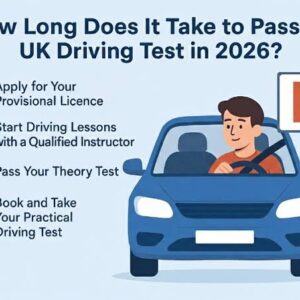
You can still drive in the UK for up to 12 months on your foreign licence. After that, you’ll need to:
- Apply for a UK provisional License
- Pass the UK theory test
- Pass the UK practical test
- Receive your full UK License in the standard way
Many experienced drivers from this group underestimate the UK test — different road layouts, mandatory observation habits, and stricter hazard perception standards catch out even long-time drivers.
How to Exchange a Designated-Country Licence (Step by Step)
- Get form D1 — download it from GOV.UK or pick one up at a Post Office.
- Complete your details accurately — name, address, and date of birth must match your supporting documents exactly.
- Gather your documents:
- Your current, valid foreign driving licence (the original, not a copy)
- Your passport or an accepted alternative ID
- Proof of UK address (a recent utility bill or bank statement)
- A passport-style photo meeting DVLA’s requirements
- A certified translation, if your licence isn’t in English (Japanese and South Korean licences require this)
- Pay the fee — £43, unless you’re exchanging an eligible EU/EEA licence issued after 1976.
- Post everything to DVLA — this must go by post; DVLA does not process this type of exchange in person.
- Wait for processing — typically around 3 weeks, though this can extend during busy periods or if additional verification is needed.
Country-Specific Quirks Worth Knowing
A few nationalities face extra steps:
- Japan and South Korea: an official certified translation must be submitted alongside the licence.
- UAE: a Licence Data Verification Letter from the UAE Ministry of Interior is required in addition to the D1 form.
- Australia, Canada, New Zealand: some licences don’t specify whether the driving test was taken in a manual or automatic vehicle — if this can’t be confirmed, your UK licence may default to an automatic-only restriction.
- Ukraine: licence holders get an extended 3-year window before exchange is required, longer than the standard 12 months.
What Happens to Your Original Licence
This trips a lot of people up: for non-EU designated-country exchanges, DVLA keeps your original licence and returns it to the issuing authority — you don’t get it back. If there’s any chance you’ll need to drive in your home country again, it’s worth checking with your original licensing authority about getting a replacement before you submit your UK exchange application.
EU/EEA licences are typically handled the same way, so the same consideration applies.
FAQs: Exchanging a Foreign Driving Licence
Do I need an International Driving Permit (IDP) to drive in the UK? No. An IDP is only a translation document — it doesn’t grant driving rights on its own, and it isn’t required in the UK if you already hold a valid licence, translated where necessary.
How long can I drive in the UK before exchanging my licence? Generally 12 months from when you become a UK resident, regardless of which tier your licence falls into — though designated-country and EU/EEA holders then get a longer window to complete the actual exchange.
What if my country isn’t on the designated list? You’ll need to apply for a provisional licence and pass both the UK theory and practical tests within your first 12 months of residency to keep driving legally afterwards.
Can I exchange a motorcycle licence the same way? Not always — some designated countries (including Ukraine) exclude motorcycle entitlement from direct exchange, meaning a UK motorcycle test may still be required even if your car licence exchanges freely.
Will my UK licence be restricted to automatic vehicles? Only if your original licence doesn’t clearly show you passed in a manual vehicle. If that’s the case, you’ll need separate evidence — or a UK manual test — to remove the restriction.
Getting Your Exchange Application Right the First Time
Missing documentation, an untranslated licence, or an incomplete D1 form are the most common reasons foreign licence exchanges get delayed or rejected. If you’d rather not risk the back-and-forth with DVLA, [Fast Track UK License] can review your application before it’s submitted and help make sure it’s accepted first time.